
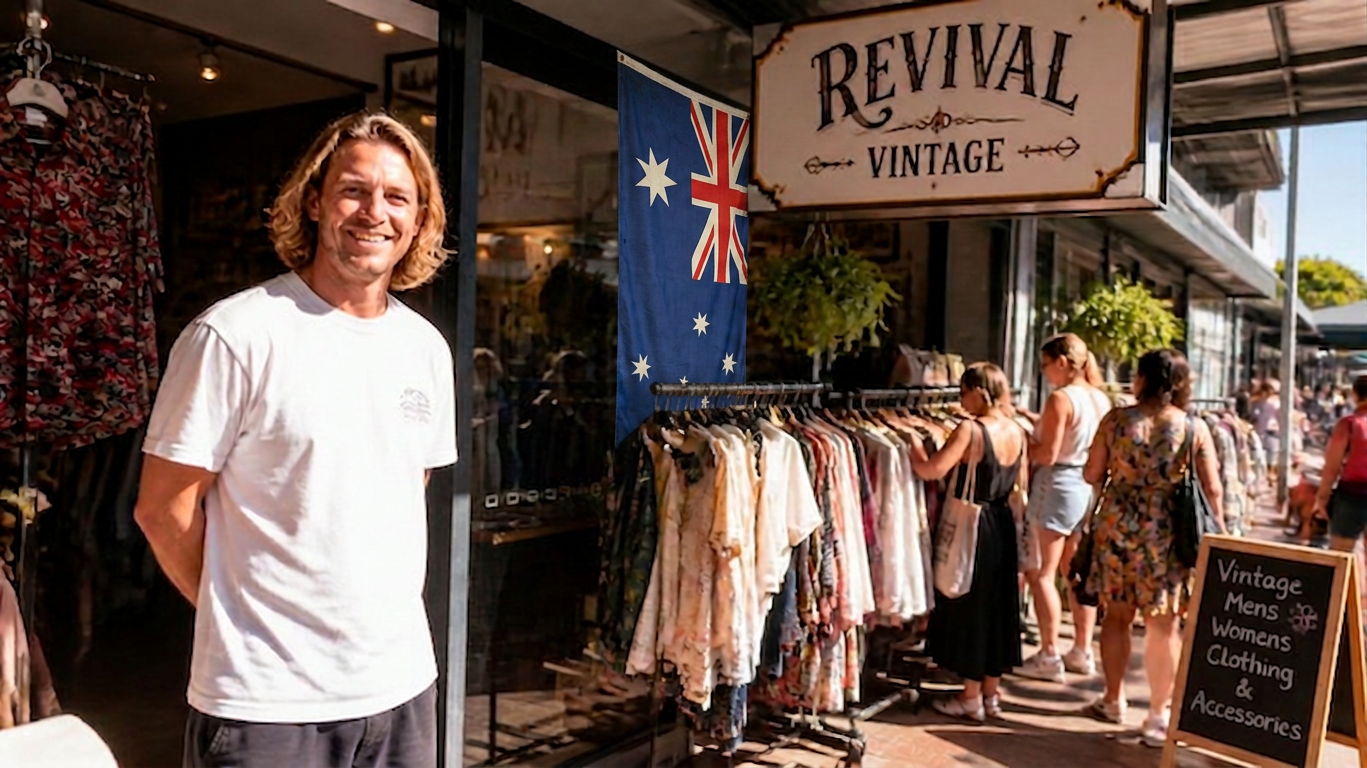
Australia Consignment & Resale Statistics 2026: What Changed Since 2024
Australia’s secondhand economy has moved from a practical post-war habit, garage sales, flea markets, and charity shops, into a mainstream, platform-driven retail category. Comparing the themes in Aravenda’s 2024 [9], Australia resale report against the data available in 2026 shows a market that has grown substantially, attracted serious platform investment, and become a genuine competitor to fast fashion for younger shoppers.
|
Metric |
2026 update |
|
Antique & Used Goods Retailing market size |
$4.9 billion (2026), up from a 2.0% five-year CAGR (2020–2025) |
|
Number of Antique & Used Goods Retailing businesses |
2,320 (2026) |
|
Australia second-hand apparel market |
USD $578.3 million (2024), projected to reach USD $1.03 billion by 2032 (7.1% CAGR) |
|
Australia real GDP growth |
2.5% annual growth to March 2026 quarter; full-year 2025 growth of 1.7–2.0% depending on source |
|
Australia population |
27,801,023 (ABS, December 31, 2025), projected to reach 28 million during 2026 |
|
Australians who bought secondhand in the past year |
72% (as of March 2026) |
Market size: Multi-Billion-Dollar, Platform-Accelerated Market
The formal “Antique & Used Goods Retailing” industry, the category closest to traditional consignment and resale storefronts, reached $4.9 billion in 2026, with 2,320 businesses operating in the sector, having grown at a compound annual growth rate of 1.0% between 2020 and 2025 for business count and 2.0% for market value over the same period. The industry is unlikely to be materially impacted by import or export tariffs, since imports and exports account for a low share of industry revenue, a notable point of stability compared to tariff-exposed retail categories elsewhere.
Fashion resale specifically is growing even faster. Australia’s second-hand apparel market was valued at USD $578.3 million in 2024, up from $396.6 million in 2018, and is projected to reach USD $1,027.1 million by 2032, expanding at a 7.1% compound annual growth rate. A separate market view puts the broader secondhand market (not limited to apparel) on a similar trajectory: market research platform Credence Research estimates Australia’s secondhand market will reach $1.5 billion by 2032 [5].
Consumer engagement has jumped sharply. 42-1 as of March 2026, 72% of Australians had bought a secondhand item in the past year, with over half buying from op shops and around a third using online platforms. By state, New South Wales holds 32% of the market, followed by Victoria at 28%, with Melbourne’s vintage and sustainability culture playing a significant role in that share.
What’s Driving the Shift
Platform competition has intensified dramatically since the 2024 report. In a major consolidation move, eBay acquired Depop from Etsy in February 2026, aiming to bolster its standing among Gen Z shoppers. Australia has emerged as a particular growth priority within that deal: Depop describes Australia as one of its “fastest-growing markets globally,” with a spokesperson noting a significant amount of money being spent specifically to grow the Australian market. A Depop spokesperson also confirmed sign-ups in Australia have grown “over 100 per cent year-on-year” as more consumers turn to secondhand shopping, describing resale as “becoming a mainstream way to shop”.
Platforms have also moved to make selling more attractive to Australian users specifically. Depop removed selling fees for Australian sellers, part of a wider fee restructuring that also introduced a marketplace fee for buyers from July 22, 2026 onward. Depop sellers in Australia who complete at least one sale generate an average of A$502 in sales in their first year on the platform, illustrating the real earning potential now available to casual resellers.
This mirrors a broader global pattern. Secondhand sales accounted for over 10% of fashion spending in January 2026 as interest continues to rise, with secondhand apparel sales set to outpace overall fashion growth over the next five years. Locally, however, growth is creating real friction for traditional charity retailers: “peer-to-peer platforms like Facebook Marketplace, Depop, and eBay have made it easier for households to sell higher-value unwanted goods directly, reducing donations of premium stock like vintage clothing, designer apparel, and furniture to opportunity shops, while discount chains including Kmart, Big W, and TK Maxx compete for the same value-focused shoppers.
Even so, long-term demand for opportunity shops is being supported by rising interest in sustainable and ethical shopping, especially among younger consumers, which is widening the overall customer base.
The Australian Economy: Cautious Recovery With Persistent Headwinds
The 2026 picture is one of a gradual, uneven recovery, still shadowed by inflation and cost-of-living pressure:
- Australia’s GDP rose 0.3% in the March 2026 quarter and 2.5% since March 2025, with modest growth reflecting subdued household and government consumption alongside adverse weather impacts that hampered mining production and exports.
- The IMF’s November 2025 Article IV Mission projected real GDP growth rising to 2.1% in 2026, from 1.8% in 2025, as recent monetary easing supports a continued recovery in private demand.
- Other forecasters see more moderate momentum: CommBank’s economists noted GDP growth had reached 1.8% by late 2025 and forecast it would hit 2.2% by the end of 2026, with consumer spending and house prices both rising, while Deloitte Access Economics forecast the Australian economy would grow 2.2% in the 2025–26 financial year before slowing to 1.3% in 2026–27.
- More recent outlooks flag renewed pressure: KPMG’s mid-2026 outlook describes an economy slowing under the weight of persistent inflation and tighter financial conditions following three RBA rate hikes in early 2026, with growth expected to remain weak throughout 2026 as the RBA balances inflation against slowing momentum.
As in other markets, this uneven and inflation-pressured backdrop is directly relevant to resale demand: rising interest in sustainable and value-focused shopping continues to widen the customer base for secondhand retail, even as some pressure on household budgets constrains overall discretionary spending.
Population: Migration-Driven Growth Continues, Though Slowing
By 2026, population growth remains a defining structural factor for the country’s retail and resale markets, though its pace has eased:
- Australia’s population reached 27,801,023 people at 31 December 2025, with annual growth of 412,500 people (1.5%), made up of 111,500 in natural increase and 301,000 in net overseas migration.
- The Centre for Population’s 2025 Population Statement projects Australia will reach 28 million people during 2026, despite population growth slowing to a record low of 1.3% for the year, down from 1.5% the year before, driven by a projected decrease in migrant arrivals and an increase in migrant departures.
- As of 30 June 2025, Australia’s population included 8.8 million people born overseas, representing 32.0% of the total population, with India, England, China, and New Zealand the largest countries of birth.
- New South Wales is projected to remain Australia’s most populous state, reaching 9.6 million people by 2035–36, about 30% of the national population, while Tasmania and South Australia are expected to be the slowest-growing states between 2026 and 2036.
Australia’s continued reliance on migration for population growth, alongside one of the highest proportions of overseas-born residents among developed nations, supports a large and demographically diverse customer base for resale platforms and consignment retailers alike, particularly in Sydney and Melbourne.
Category Spotlight: Fashio, Furniture, and the Rise of Crosslisting
The 2024 report highlighted vintage and designer clothing, furniture, and household goods as strong categories for Australian consignment. The 2026 data confirm and sharpen that picture:
- Reselling trend data from early 2026 shows outerwear, knitwear, and boots in peak seasonal demand on platforms like Depop, with resellers increasingly listing across multiple platforms, eBay, Depop, Facebook Marketplace, and Grailed, simultaneously to reach different buyer segments and price points.
- Furniture and household goods have long been strong secondhand categories in Australia; historical survey data shows office furniture and dining tables ranking among the items Australians are most likely to consider buying secondhand alongside strong interest in homeware, appliances, and consumer electronics through company buy-back and resale programs.
- Online marketplaces remain the leading way Australians buy and sell used goods, with popular platforms including eBay, Amazon, Gumtree, Kogan, Catch, MyDeal, and Depop.
- Even institutional and charitable players are experimenting with new formats to reach younger shoppers: The Salvation Army launched a thrift store inside the gaming platform Roblox in February 2026, modeling a real Salvation Army store stocked with player donations, original designer content, and digital replicas of its physical stores’ actual merchandise, a notable sign of how far resale culture has permeated Australia’s youngest consumers.
What Hasn’t Changed
Some structural features of Australia’s resale market remain consistent with the themes in the 2024 report:
- Op shops and charitable resale retailers remain central to Australian secondhand culture, even as they face new competition. Many resale shops continue to be operated by charitable organizations playing a role in community wellbeing, alongside a growing wave of high-end consignment boutiques in major cities offering curated designer and luxury selections.
- Affordability and sustainability remain intertwined motivators. Australians continue to cite both cost-of-living pressure and environmental concern as reasons for buying secondhand a dual appeal consistent with the 2024 report’s framing.
- Fragmentation persists at the retail level. With 2,320 businesses in the formal Antique & Used Goods Retailing sector alone, plus a much larger, harder-to-count layer of individual resellers on peer-to-peer platforms, Australia’s resale market remains highly fragmented rather than dominated by a handful of large players
FAQ: Starting and Understanding Consignment Resale in Australia
How do I start a consignment business in Australia?
Choose your niche (designer and vintage fashion, furniture, homeware, electronics, or a general mix), register your business with the Australian Business Register to obtain an ABN, and decide whether you’ll operate from a physical shop, online-only, or a hybrid model. From the outset, put consignor agreements in place, covering commission splits, payout schedules, and unsold-item terms, and use inventory management software rather than spreadsheets, since tracking multiple consignors manually quickly becomes unmanageable as your business grows.
How much money do I need to open a store in Australia?
Costs depend heavily on format and location. A physical shop in a major city like Sydney or Melbourne typically requires funds for lease and deposit, shopfitting, point-of-sale and inventory software, and initial marketing, with costs generally higher in inner-city and high-foot-traffic areas. An online-first or hybrid consignment model, increasingly common given how quickly Australian resale platforms are growing, can launch with substantially less capital, since there’s no upfront inventory purchase and lower ongoing overhead than a traditional retail lease.
What category sells the most in Australia?
Fashion and apparel lead Australia’s resale market by transaction volume, with outerwear, knitwear, and footwear among the strongest-performing categories on platforms like Depop and eBay. Furniture, homeware, and consumer electronics also perform consistently well, particularly through buy-back and resale programs, while op shops continue to move a steady volume of everyday clothing and household goods across the country.
Is consignment reselling profitable in Australia in 2026?
Consignment carries relatively low financial risk since inventory isn’t paid for upfront, and Australia’s resale sector has continued to grow briskly even as broader GDP growth has been uneven, a pattern consistent with resale’s reputation as a resilient category during periods of cost-of-living pressure. Actual profitability depends on your commission structure, how quickly inventory turns over, and controlling labor costs for item intake and listing, and it’s worth noting that increased competition from peer-to-peer platforms has made sourcing premium donated stock more difficult for some traditional resellers.
Do I need special licensing to run a consignment shop in Australia?
Requirements vary by state and local council, but generally you’ll need an ABN, to register for GST if turnover exceeds the threshold, and any local council permits required for retail trading. Certain categories, such as electricals, items subject to Australian safety and consumer law requirements, or high-value jewelry, may carry additional compliance obligations, so it’s worth checking category-specific and state-specific rules before listing inventory.
Ready to Grow Your Consignment or Resale Business in Australia?
Whether you’re opening your first consignment boutique in Sydney or Melbourne or scaling a multi-location resale operation across Australia, Aravenda Consignment Software supports every stage of the journey, from personalized onboarding and AI-powered item entry, to multi-location and multi-consignor inventory management, to a fully integrated Shopify storefront that helps you sell online and in-store from day one. As Australia’s resale market continues its rapid platform-driven growth in 2026, Aravenda gives consignment and resale businesses the tools to manage inventory, consignor payouts, and sales, all in one place.
Start your free trial | View a demo | Explore pricing
Sources:
[1] Australian Bureau of Statistics (ABS)
[2]Reserve Bank of Australia (RBA)
[3] IMF’s 2025 Article IV Mission for Australia
[7] Shopfront’s Australian reselling trends report
[8] Aravenda’s “Australia” resale statistics page (2024) with data available as of August 2026.