
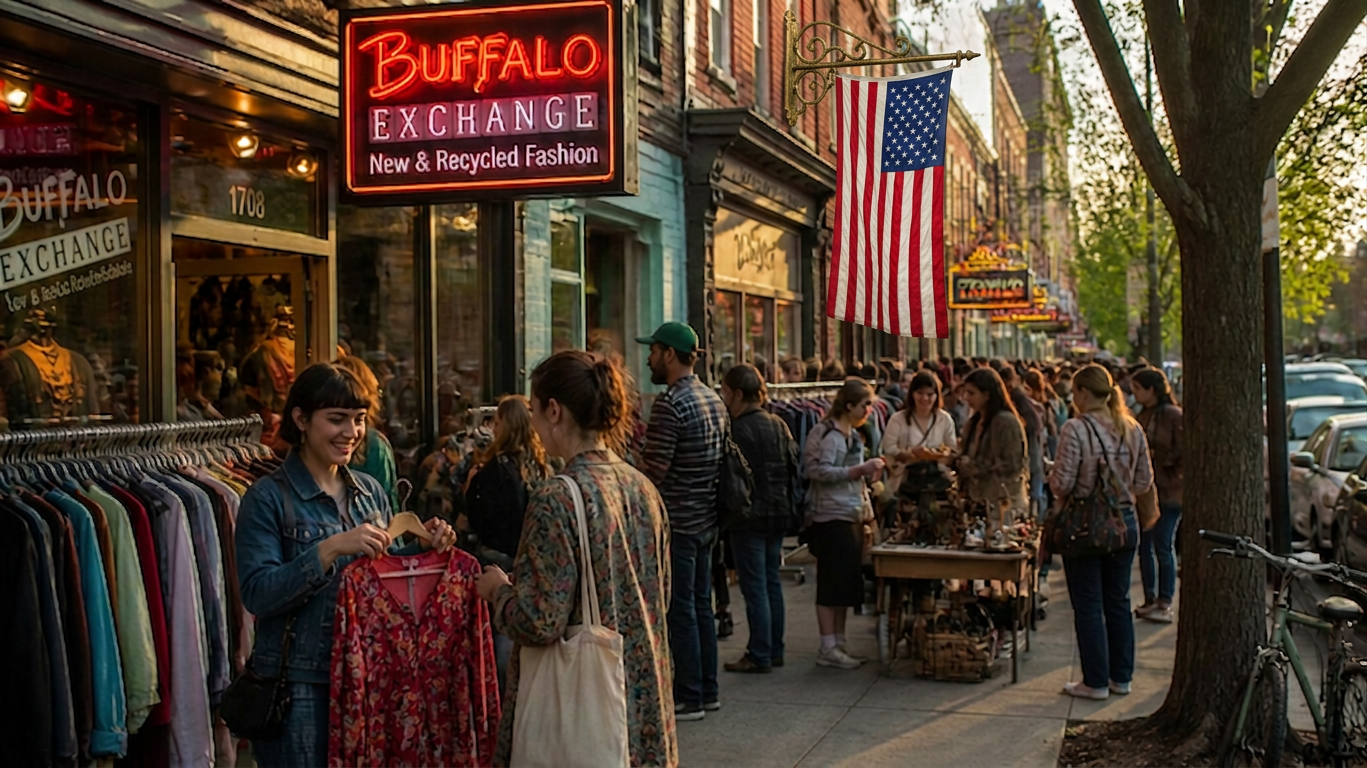
USA Consignment and Resale Statistics
The United States has the largest resale market in the world. The brick-and-mortar Used Goods Stores industry generates an estimated $27.7 billion in annual revenue (2025) across roughly 87,112 businesses, while the broader U.S. secondhand apparel market, including online resale, grew 13% in 2025 and is projected to reach $78.8 billion by 2030. Resale is growing nearly 4 times faster than traditional retail clothing sales, and the trend shows no signs of slowing [2].
Key 2025-2026 U.S. Resale Statistics At a Glance
- Used Goods Stores market size: $27.7 billion (2025), up 0.9% year-over-year, following 5.9% CAGR growth from 2020-2025 [1].
- Number of used goods/consignment businesses: 87,112 in the U.S. (2025), up 1.4% from 2024, growing at a 1.1% CAGR since 2020 [1].
- Industry employment: 307,143 people employed in used goods stores (2025), up 1.2% year-over-year [1].
- U.S. secondhand apparel market growth: Grew 13% in 2025, nearly 4x faster than the broader retail clothing market’s 3.6% growth [2].
- Curated/higher-value U.S. resale segment growth: Grew 19% in 2025 [3].
- U.S. secondhand apparel market forecast: Projected to reach $78.8 billion by 2030, a 7.3% CAGR [2].
- Online resale forecast: Expected to nearly double by 2030, reaching $48.3 billion [3].
- U.S. real GDP growth: 2.1% in 2025, following 2.8% in 2024 [4].
- U.S. population: 341,784,857 (2025 official Census estimate), growing just 0.5%, the slowest pace since the early COVID-19 pandemic [5].
- Global sneaker resale market: Valued at $10.6 billion in 2025, with the U.S. as the single largest national market [6].
U.S. Economic & Resale Facts
GDP real growth rate: The U.S. economy grew by 2.1% in 2025 (second estimate), down from 2.8% growth in 2024, according to the Bureau of Economic Analysis. Quarterly growth was uneven across the year, including a strong 4.4% annualized rate in Q3 2025, reflecting continued volatility in consumer spending, investment, and trade [4].
Used Goods Stores industry size: $27.7 billion in 2025, up 0.9% from $27.4 billion in 2024, continuing a strong 5.9% compound annual growth rate since 2020 [1]. The industry has proven resilient through economic cycles, drawing consumers with both necessity-driven and lifestyle-driven motivations, value-seeking during downturns, and sustainable, treasure-hunt-style shopping during periods of growth [7].
Consignment and used goods businesses: An estimated 87,112 used goods stores operate across the U.S. in 2025, up 1.4% from 86,936 in 2024. These businesses employ roughly 307,143 people nationwide.1 Broader assortments, curated collections, and digital sales growth through platforms like eBay and ThredUp have reinforced the industry’s staying power even in an uncertain broader retail environment [7].
U.S. secondhand apparel market: According to ThredUp’s 2026 Resale Report (conducted by GlobalData), the U.S. secondhand apparel market grew 13% in 2025, nearly four times faster than the broader retail clothing market’s 3.6% growth [2]. The curated, higher-value resale segment (the kind of inventory typical of consignment boutiques) grew even faster, at 19% [3]. Looking ahead, the U.S. secondhand market is projected to reach $78.8 billion by 2030, a 7.3% compound annual growth rate, while online resale specifically is expected to nearly double to $48.3 billion by 2030.
Where the growth is coming from: Gen Z and Millennials are expected to drive more than 70% of resale market growth through 2030, with new shoppers accounting for the majority of incremental spend [2]. Technology is accelerating adoption on both sides of the market, 48% of secondhand shoppers say they now use AI tools during their shopping journey, and 63% say they’re comfortable with agentic (AI-assisted) buying. On the supply side, ThredUp estimates that making selling as easy as buying could unlock an additional $23.3 billion in U.S. market value, as the industry’s current growth constraint has shifted from demand to supply [8].
Population: The U.S. population reached an official estimate of 341,784,857 in 2025, according to the U.S. Census Bureau’s Vintage 2025 estimates. Population growth slowed sharply to just 0.5% between July 2024 and July 2025, the nation’s slowest growth rate since the early COVID-19 pandemic, driven by a steep decline in net international migration, which fell from 2.7 million to 1.3 million over the period [5].
The used and secondhand goods market in the U.S. spans an especially wide range of categories: pre-owned sneakers and streetwear, art and antiques, vintage collectibles, furniture and home decor, women’s, men’s, and children’s clothing, jewelry, handbags, luxury goods and watches, kids’ gear and toys, electronics, books, sporting goods, musical instruments, and more.
Sneaker resale stats: The global sneaker resale market reached an estimated $10.6 billion in 2025, with the U.S. serving as the largest single national market [6]. Air Jordan and Nike have historically dominated the category, combining for roughly 71% market share, while online marketplaces have become the dominant resale channel [9]. Consignment-style sneaker resale, where a store lists and sells on a seller’s behalf for a revenue split, typically 80-90% to the consignor, has become especially popular, pioneered by stores like Flight Club and now replicated by hundreds of independent shops nationwide [10].
History of resale in the United States
Resale and consignment have deep roots in American retail, dating back to the 19th and early 20th centuries when secondhand stores emerged as a way for individuals to sell or exchange used goods. Thrift stores tied to charitable causes, like Goodwill (founded 1902) and the Salvation Army, established the model of secondhand retail as both a commercial enterprise and a social good, a combination that persists in the industry today.
In recent decades, the U.S. resale and consignment industry has experienced enormous growth, accelerated by environmental and sustainability concerns, the rise of e-commerce platforms like eBay, and more recently, the emergence of dedicated resale marketplaces such as Poshmark, ThredUp, The RealReal, Depop, and StockX. What began as a niche or necessity-driven category has become a mainstream shopping behavior across every generation, with younger consumers in particular treating resale as a first choice rather than a last resort.
Why the United States is a great place to open a consignment resale business
Resale is a recession-resistant business, and the U.S. market is proof: the Used Goods Stores industry has grown steadily through multiple economic cycles, drawing both value-conscious shoppers during downturns and sustainability-minded shoppers during periods of economic strength [7].
The scale of opportunity is significant. With 87,112 existing used goods businesses generating $27.7 billion in revenue [1], and the broader secondhand apparel category alone forecast to nearly triple from current levels by 2030 [2], the U.S. offers one of the deepest and most diversified resale markets in the world, spanning brick-and-mortar consignment boutiques, thrift and charity retail, curated online resale, and specialty categories like sneaker and streetwear consignment.
Brands themselves are increasingly participating rather than competing: major retailers now run in-house resale and trade-in programs, treating secondhand as a growth channel rather than a threat to new sales. Combined with technology that increasingly automates pricing, listing, and authentication, U.S. consignment businesses have more infrastructure and consumer demand behind them than at any point in the industry’s history.
Benefits of Consignment
Consignment reselling, compared to traditional retail where items are paid for upfront then resold, has several advantages:
Advantages for consignment retailers
- Low financial risk: Because retailers don’t pay for products until they’re sold, purchasing surplus stock and losing capital on inventory costs isn’t a concern. Consignment inventory allows retailers with tight margins to take on new products without assuming financial risk for unsold goods.
- Higher potential for sales: Consigned goods diversify retail inventory, which can increase sales and profits.
- Fewer storage needs: New stock can be brought in whenever there’s customer demand. Retailers don’t need special storage arrangements for excess stock and can return unsold products.
Consignment inventory advantages for suppliers
- Visibility: Consignment gives suppliers a way to reach new audiences through retail stores, generating revenue without owning retail space or hiring staff.
- Testing: Suppliers can test new products in new markets and evaluate performance based on actual sales.
- Reduced inventory costs: Placing goods with retail partners until they sell can reduce warehouse carrying costs.
Consumer attitudes towards used goods in the United States
Gen Z and Millennial consumers are the clear engine of U.S. resale growth, expected to drive more than 70% of the market’s expansion through 2030 [2]. Consumers increasingly treat resale as part of a full “buy, wear, resell, reinvest” cycle rather than a one-off purchase decision, with ThredUp’s most engaged users participating on both the buy and sell side of the market. Clean-out and reselling activity among existing sellers rose 34% year-over-year in 2025, with supply from those sellers up 14% [8].
FAQ: U.S. Consignment & Resale Market
How do I start a consignment business in USA?
Start with a niche (clothing, furniture, kids’ gear, luxury goods, sporting equipment) rather than trying to sell everything. Then work through the practical steps: write a simple business plan, choose a legal structure (LLC is common for liability protection), register your business name, get a resale/seller’s permit from your state, find a location or decide to go online-only, set up point-of-sale and consignment-tracking software, and draft your consignor agreement (this spells out your split, how long items stay on the floor, and what happens to unsold goods). Many owners start by consigning out of a small storefront or booth and expand once they’ve proven demand locally.
How much money do I need to open a consignment store in USA?
It varies widely by format:
- Online/home-based consignment: as little as $500–$3,000 to cover a business license, basic software, and starting marketing.
- Small brick-and-mortar shop: typically $10,000–$50,000, covering first/last month’s rent, fixtures (racks, shelving, mirrors), POS and consignment software, signage, and initial marketing.
- Larger or franchise consignment store: $50,000–$150,000+, especially if you’re buying fixtures new, renovating a space, or paying franchise fees.
Because consignment inventory is provided by consignors (not purchased upfront), consignment stores are notably cheaper to launch than traditional retail, your biggest costs are rent, software, and fixtures rather than inventory.
What category sells the most in USA?
Apparel and accessories remain the largest resale category by volume in the U.S., with women’s clothing typically the top-selling segment, followed by handbags, shoes, and children’s clothing. Resale accounts for 7.9% of all apparel e-commerce sales in the U.S., with online apparel resale sales projected to total $23.9 billion in 2026, or 8.4% of fashion e-commerce. Beyond apparel, furniture and home goods, luxury handbags/jewelry, and children’s items (clothing, gear, toys) are also strong performers, since these categories combine high original price points with steady demand for secondhand versions.
Is consignment reselling profitable in USA in 2026?
Yes, and the broader market backs that up. U.S. resale grew 19% in 2025 alone, nearly four times faster than traditional retail, and the U.S. secondhand market is worth an estimated $61 billion in 2026, up 8.2% from 2025. On the shop-owner economics side, most consignment shops pay merchandise owners 40 to 60% of the selling price of the item sold, which means the store typically keeps 40–60% margin on every sale without paying upfront for inventor, a structural advantage over traditional retail. That said, profitability still depends on foot traffic or online sales volume, keeping fresh inventory flowing in from consignors, and controlling overhead (rent, staff, software). Independent, niche-focused shops are seen as well-positioned to keep thriving in 2026, since curation and community loyalty are hard for big platforms to replicate.
Do I need special licensing to run a consignment shop in USA?
You’ll need the same basics most retailers need, a general business license, a state seller’s/resale permit (to collect and remit sales tax), and possibly a local zoning or occupancy permit if you have a physical storefront. Consignment itself isn’t usually a separately licensed activity, but a few things are worth flagging:
- Some states/cities require secondhand dealer permits for certain categories (jewelry, electronics, firearms) to deter resale of stolen goods, often with record-keeping requirements.
- If you sell items like firearms, alcohol, or vehicles on consignment, those categories carry their own specific licensing.
- You don’t need a separate tax ID for consignors, but you’re responsible for issuing them accurate payout records (1099s may apply if a consignor earns over IRS reporting thresholds in a year).
Since requirements vary by state and city, it’s worth a quick call to your local city clerk or Secretary of State’s office to confirm what applies to your specific location and category before opening.
Country Snapshot
Country: United States of America Capital City: Washington, D.C. Currency: U.S. dollar Language: English (no official federal language; English is the de facto national language) Population: 341,784,857 (2025 official Census estimate) [5].
Aravenda services available:
- Full-service consignment software: resale inventory management including consignor payouts
- AI powered item entry: upload a photo, UPC or code and list in literally seconds
- Personalized onboarding with an assigned specialist to assist you
- Website development and creation (fully integrated with Shopify)
- Shopify website creation and updates
- Customized, White Label Enterprise product for larger enterprise customers
Grow your consignment and resale business with Aravenda Consignment Software
Propel your consignment business to new heights with Aravenda, the best consignment software solution.
Free trial | View a demo | Quickstart guide
Sources:
[4] U.S. Bureau of Economic Analysis, “GDP (Second Estimate), 4th Quarter and Year 2025,” 2026.
[6] DataM Intelligence, “Sneaker Resale Market Size, Growth Analysis & Forecast 2035,” May 2026.
[7] IBISWorld, “Used Goods Stores in the US Industry Data and Analysis,” December 2025.
[9] RunRepeat, “Sneaker Resale Statistics.”
[10] StackKnack, “How Does the Sneaker Resale Market Work in 2026?”